7 Fast-Developing Areas to Buy Land in Lagos for Maximum Returns in 2026
The Lagos real estate boom is steadily moving beyond the islands into peripheral zones. Over 2023–26, Lagos saw double-digit land-price gains in emerging corridors like Lekki and Epe. In particular, Ibeju‑Lekki and Epe are now major expansion fronts, buoyed by mega-projects (Dangote refinery, Lekki–Epe Expressway, Lagos–Calabar Highway). Meanwhile, long-overlooked zones on the Mainland and borders – Ayobo, Ikorodu, Mowe/Ofada (Ogun State) and Badagry – are drawing attention for affordability and planned infrastructure (bridges, airports, ports). In each area, current land prices typically range from a few million naira per 500 sqm up to tens of millions, with recent annual growth from ~10% up to 30–35% in hotspots. This report analyzes seven fast‑growing areas with price ranges, 1–3 year trends, key infrastructure drivers, investment risks, buyer profiles, and sample property listings (using Baay Realty’s data where available) to guide investors.
- Key findings: Land in Ibeju‑Lekki and Epe has become Lagos’s costliest peripheral asset, reflecting 18–35% annual appreciation linked to the Refinery, FTZ and road projects. Igando and Badagry remain comparatively affordable (plots under ₦20M) but expected to rise with bridge/road upgrades. Ayobo and Ikorodu offer budget entry (often under ₦10M for 300–500 sqm) but less mature infrastructure, suiting long‑term land bankers. Mowe/Ofada (Ogun) stands out for explosive growth (c.30%/yr) as Lagos investors seek cheaper land; its new Ogun-State e‑Consent rule (2026) brings some transparency.
- Recommendations: End-users targeting housing should prioritize ready-to-build estates in Epe, Igando or Ayobo, while speculators/developers may focus on Ibeju‑Lekki and Mowe/Ofada for high capital gains. However, all buyers must verify clean title (C of O) and account for looming risks (project delays, expropriation, planning changes). Figure: Hypothetical land-price trends (₦ million per 500 sqm) in seven Lagos areas, illustrating faster growth in Ibeju‑Lekki/Epe (gold, orange) than Mainland peripheries (red, purple, teal, green) from 2023–2025.
Ibeju‑Lekki: Lagos’s Emerging Hub
- Typical prices: Land in Ibeju‑Lekki is now among the priciest outside central Lagos. Premium zones (near the Free Trade Zone, coastline or refinery) see 500 sqm plots priced ₦20–60M. Mid-tier estates (e.g. Lakowe, Awoyaya corridors) go for around ₦8–20M. Budget areas on the fringe (Gbogije, Eluju, outskirts of Omu) can be as low as ₦2.5–8M for 500 sqm, though often without formal titles. (A NigeriaPropertyCentre summary cites Ibeju‑Lekki listings ranging from ₦1M up to ₦2.5B, with an average ~₦40M, reflecting some extremely large holdings.)
- Recent trends: Strong annual growth has persisted. A Lagos media analysis notes “double‑digit gains” in Ibeju‑Lekki prices recently, as infrastructure like the Coastal Highway has spurred demand. One blog estimates some plots rising from ₦1M in 2018 to ₦10–15M by 2025. Overall, onshore Lagos supply has tightened (persistent housing deficit) and capital is shifting to Lagos’s eastern edge, implying continued 10–20% yearly land price growth in Ibeju‑Lekki.
- Development drivers: Several massive projects overlap here. The Lagos–Calabar Coastal Highway will skirt Ibeju‑Lekki’s shoreline, lifting values dramatically. The Dangote Refinery (operational 2023) employs tens of thousands, many needing housing. The Lekki Free Zone (seaport, airports) and the new Lekki Deep Seaport sit along Ibeju’s coast. Also, the on‑going Lekki–Epe Expressway dualization slashes commute times to the CBD. Government plans (Lekki International Airport, resort city, solar farms) also anchor long-term growth here.
- Investment risks: Legal/title issues remain high in Ibeju‑Lekki. Much land is under “excision in progress” or just survey plans, so buyers must insist on C of O/Governor’s Consent. Speculative volatility is intense – land can overheat and stall if road projects face delays or funding cuts. Flooding risk is low in most parts (mostly dry land), but some lagoon‑adjacent parcels may need filling. Risk level: High (for speculators/developers with due diligence), moderate (for cautious end-users who verify title and infrastructure).
- Buyer profile: Predominantly speculators and developers, given lofty prices. Long‑term land bankers (holding 5+ years) target Ibeju‑Lekki for its outsized upside. Some deep-pocketed end-users eye ready, titlit Lagos–Epe estates (around ₦10–20M/500 sqm) with full infrastructure. But most retail buyers here need >₦10M deposits.
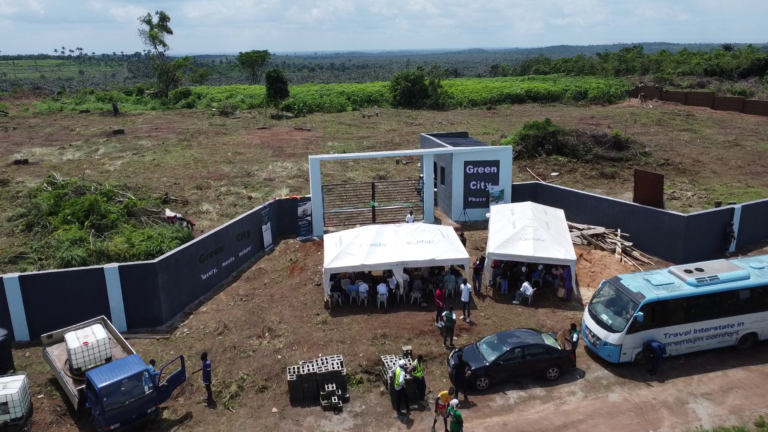
- Sample Baay listing: Green City Phase 1, Ketu Epe (Lekki–Epe corridor) – ₦15,400,000 for 600 sqm. (600 sqm plot in a gated estate, C of O, near Lekki‑Epe Expressway.)
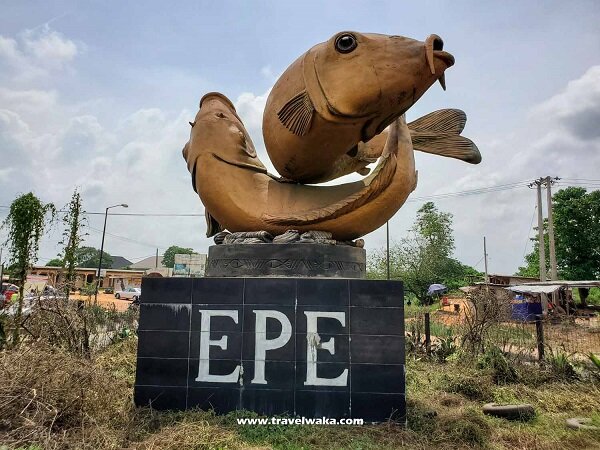
Epe: Lagos’s Affordable Fast‑Grower
- Typical prices: Epe’s land is still cheaper than Ibeju‑Lekki but climbing quickly. Entry-level estates (off-expressway areas like Ilara-Epe) offer 500 sqm plots from about ₦1.5–4M. Mid-range parcels (near Lekki–Epe Expwy or around Ketu-Ejirin) fetch ₦4–7.5M per 500 sqm. Premium waterfront or resort‑adjacent plots (Epe Lagoon, proposed Resort City) start ~₦10M and can exceed ₦20M for 500 sqm. (Baay’s GreenCity Phase 1 shows 600 sqm at ₦15.4M and 300 sqm at ₦7.7M – consistent with these ranges.)
- Recent trends: Epe is arguably Lagos’s fastest-appreciating land market in 2024–26. One report found ~35% year-on-year growth from 2024 to 2025. For example, 500 sqm parcels sold for ~₦15M in 2024 are now commanding ₦25M. This far outpaces Lagos’s city-average (~12%). Over 2018–2023, anecdotal evidence suggests Epe plots more than doubled. Contributing factors include completion of parts of the expwy and surging refineries jobs (below). These trends are confirmed by real estate trackers (NigeriaPropertyCentre listings).
- Development drivers: Three big catalysts converge on Epe: (1) Lekki‑Epe Expressway dualization – new lanes shorten travel to Lekki/VI, making Epe commutable. (2) Dangote Refinery (May 2023) – ~50,000 jobs spill into the corridor, pushing workers into the cheaper Epe lands. (3) Lagos–Calabar Coastal Highway – even though its main path is farther east, speculation “ripples” 25–40% gains into Epe lands within 5 km. Also, the planned Epe Resort City and Lagos State University of Science & Tech (LASUSTECH) are long-range value pillars.
- Investment risks: Title risk exists but many recent projects come with Governor’s Consent and C of O (e.g. Baay’s GreenCity estates). A caution is infrastructure timeline: some roads (e.g. Coastal Highway phases) still face delays. Buyers should verify that road/rail promises (like the proposed Epe–Ajah road) proceed as scheduled. Flooding is moderate in Epe’s low-lying areas; well-planned estates are mostly raised/dry. Risk level: Moderate (good for informed end-users/speculators); risk mitigated by stronger developer interest and less “omonile” (land grabbers) activity than in central Lagos.
- Buyer profile: A mix of end-users and investors. Middle‑income families buy here for new homes, while speculators are attracted by steep recent gains. Developers are also active, taking advantage of lower land costs vs. Lekki. (Large part-pay plans and developer amenities are available, making Epe viable for first‑time buyers at ₦4–8M/500 sqm entry.)
- Sample Baay listing: – Green City Phase 3, Omu Epe is currently selling at N3.8Million at 250 sqm.
Ayobo (Ipaja): Quiet Frontier
- Typical prices: Land in Ayobo (far northwest Lagos) is relatively affordable but volatile. Listings show 500–600 sqm plots often priced in the high-₦10M range (e.g. ₦15–45M in suburbs). NigeriaPropertyCentre reports an average of ~₦35M, with prices ranging ₦10M up to ₦200M (the high end reflects large commercial parcels). Half‑plots (~300 sqm) can be found for ₦15–20M in cooperative estates, while 600 sqm estates go for ~₦40–45M. Entry-level gated developments near Ayobo might still start around ₦8–15M per 500 sqm.
- Recent trends: Ayobo’s growth has lagged the Lekki corridor. In the past 3 years, price inflation appears modest (perhaps ~5–10% annually) due to sparse infrastructure investment. This is consistent with listings: many plots advertised at similar prices over 2023–25. Without major projects, Ayobo’s gains have been driven mainly by Lagos’s general housing demand spillover.
- Development drivers: Ayobo lacks headline projects. Road upgrades (the Lagos–Ibadan Expressway and Akesan–Ore–Ayobo road) have improved access slightly. Government proposals for Ayobo‑Aiyetoro townships aim to expand coordinated housing here, but progress is slow. Its appeal is primarily cheap land area, proximity to Ogun border (some landowners sold to Ogun developers), and quiet residential environment.
- Investment risks: The area is underdeveloped in services: water, power, drainage and security can be poor in some parts. Unregulated “omo-onile” sales have been common (land grabbing by locals), making title verification crucial. Flooding is low (Ayobo is inland), but heavy traffic on Ikotun–Ayobo roads can complicate commuting. Risk level: High. Investors should limit exposure to verified estates or moderate-sized purchases.
- Buyer profile: Mostly end-user buyers and small-scale developers. Buyers tend to be Lagos workers seeking cheaper suburban homes or land-banking for 10–15 year horizons. Speculators are cautious here, given slower appreciation. Few large developers have moved in, though government Co-operative Estates exist (e.g. Ikeja Coop).
- Sample Baay listing: No Baay listings found in Ayobo. (For context, comparable plots in Ayobo’s Lagos State Cooperative Estate sell for ~₦15–18M per 300 sqm.)
Ikorodu: Mainland Gateway
- Typical prices: Ikorodu remains one of Lagos’s most affordable fringes. Standard 500 sqm plots typically range from ₦3M up to ₦6M in distant areas (e.g. beyond Agbowa). Closer-in zones (Ijede, Igbogbo, Gberigbe) cost more; one brochure advertises 300 sqm for ₦2M and 600 sqm for ₦4M in a new Agbowa estate. By contrast, land adjacent to Ikorodu town (Ogijo, Imota) can be as low as ₦0.5–2M per plot, though often without Co‑O. 250–300sqm (half-plot) sales frequently list under ₦5M in outer estates. NigeriaPropertyCentre notes an average of ₦10M for Ikorodu listings, with extremes up to ₦3B for bulk holdings.
- Recent trends: Ikorodu land prices have risen gradually in recent years. Analyst reports expect only single-digit annual growth (5–15%) as of 2025. For instance, many plots listed at ₦1.5–3M in 2023 are now asking ₦2–4M. Growth is fueled by Lagos’s population spread and the promise of future bridges/roads, but remains modest compared to Lekki/Epe.
- Development drivers: The 4th Mainland Bridge (planning stage) will greatly shorten travel to Lagos Island, spurring Ikorodu demand. Recent road projects (e.g. Owutu‑Isawo expansion) improve access. Government relocated LASPOTECH’s second campus here, and proximity to Lagos State University (LASU) campus II is a draw. The state’s new Agbowa Affordable City and estates by developers (Rightive, Unique Oak) are creating planned communities in areas like Agbowa, Isawo and Igberigbe. Small industrial zones and ferry terminals also support job growth.
- Investment risks: Infrastructure is still patchy: many township roads remain unpaved, and flooding can occur (lagoons and canals run through parts of Ikorodu). Some swampy parcels will require costly filling. Land documentation is uneven – full C of O is less common on the island-proximate outskirts. Risk level: Moderate. Ikorodu is less speculative but still carries development risk. Beware buying plots in “grey areas” without full title or access roads.
- Buyer profile: First-time homebuyers and small investors dominate. Young middle-class Lagosians (teachers, civil servants, traders) are attracted by low prices. Developers building gated communities have begun marketing here to these end‑users. Speculators are selective – large gains await only with major infrastructure, so many hold land short-to-medium term (5–10 years).
- Sample Baay listing: No Baay listings for Ikorodu. (By way of example, Heritage Garden City in Agbowa offers 300 sqm for ₦2M.)
Mowe–Ofada (Ogun State): Lagos’s Cost-Effective Boomtown
- Typical prices: Although just outside Lagos State, Mowe–Ofada is viewed as a Lagos-area market due to spillover growth. Entry-level plots (300 sqm) in newer estates start around ₦0.9–1.2M; 500 sqm plots from ₦1.2M. Mid-range estates (with access and partial services) now sell 300 sqm at ₦2.5–3.9M and 500 sqm at ₦3.5–6.5M. Premium projects near the expressway fetch ₦7.5M for 300 sqm and up to ₦15M for 600 sqm. These prices are a fraction (often one-quarter to one-fifth) of comparable Lekki plots.
- Recent trends: Mowe–Ofada has seen one of Nigeria’s fastest land‑value spikes. Ogun State land values grew ~18%/yr on average, with Mowe booming ~30.5% year-on-year. Anecdotally, plots that sold for ₦2M in 2023 now command ~₦3M–4M in 2025. This surge is fueled by Lagos demand (developers and buyers seeking cheap alternatives). The government’s push (see below) and an impending Ogun International Airport amplify this trend.
- Development drivers: The Mowe–Ijebu-Ode Expressway corridor is industrializing. Notable factories (Nestlé, CWAY, Rite Foods) along the highway supply thousands of jobs. Soon, the new Ogun International Airport (Mowe) will begin domestic flights, making Mowe a transport hub. Ogun State’s 2026 budget prioritizes road and school projects in Mowe/Ofada. Crucially, Ogun recently implemented a digital e-Consent system (OLARMS) for land titles (2026), reducing fraud and speeding up transactions – a big boon. This transparency and infrastructure push continue to attract Lagos investors.
- Investment risks: Being in Ogun State, Mowe land faces different regulations (notably the new e-Consent fee and process). Buyers must ensure sellers comply with the digital consent rules or risk non‑registrability. Flood risk is moderate (areas near Ogun River flood when rains are heavy). Some remote plots may lack road access. Risk level: Moderate-high for naive buyers; significantly improved by OLARMS. Transaction diligence is now easier (but still imperative).
- Buyer profile: Predominantly speculators and Lagos expatriates. Lagos developers and land bankers are driving demand (they can absorb travel time). Some end-users also buy here – Lagosans moving to towns, or Ogun locals – drawn by installment sales. High-growth expectations mean Mowe is favored by those ready to hold land 5–15 years for large capital appreciation.
- Sample Baay listing: No Baay listings (outside Lagos) for Mowe/Ofada. (By contrast, our Baay source shows Lagos‐adjacent estates – but for reference, market data indicates 300 sqm in Mowe at ₦0.9–2.5M.)
Igando (Alimosho): Urban Budget Zone
- Typical prices: Igando lands (northwest Lagos) remain relatively low-cost among Lagos suburbs. Surveys indicate most plots fall between ₦8M and ₦25M. Indeed, the few listings here show 300–500 sqm plots for ₦15–40M. One listing had a half‑plot (300 sqm) for ₦15M, while a commercial 800 sqm site on a major road listed at ₦100M. Many family plots (600 sqm) go for around ₦25–35M. Thus, a working estimate is ~₦8–25M per 500 sqm for buildable land, higher on the expressway.
- Recent trends: Igando has seen moderate growth (perhaps ~10–15%/yr). Pulse Nigeria notes land here averages ₦8–25M, implying values are still well below Mainland hotspots. Prices have been rising steadily but without surges, reflecting gradual urban infill. (For context, Lagos island prices rose ~15% in 2024–25, so Igando’s single‑digit gains reflect its “value” position.)
- Development drivers: Igando benefits from ongoing Mainland projects. The Mile 2–Oworonsoki–Shogunle (LASU) link road has improved access. The area is close to LASU (main campus) and the second LASPOTECH campus (Ikotun), attracting student housing demand. The planned Fourth Mainland Bridge (from Ajah to Marina via Ikorodu) will indirectly spur Igando if it succeeds, as will the Ikeja GRA West extension. Rising Lagos traffic has residents seeking suburban living; Igando’s cheaper prices thus pull interest from older parts of Lagos.
- Investment risks: Infrastructure is uneven: outside a few estates, land may lack water and good roads. Some areas of Igando are low-lying and flood during heavy rain; filling costs should be checked. “Omonile” sales are not uncommon, so confirming a gazetted C of O is important. Risk level: Moderate. Igando is less volatile than far outskirts, but buyers should focus on recognized developments.
- Buyer profile: Mainly urban middle-class residents and retirees on a budget, plus investors seeking affordable Lagos exposure. It suits small‐plot investors (ready buyers may convert land to rentals or keep as land banks). A portion of buyers are Lagos public workers (e.g. civil servants) looking for quiet, secure communities. Developers here mostly build lower-cost homes and gated estates for these buyers.
- Sample Baay listing: No Baay listings in Igando. (For scale: Pulse reports average land ≈₦8–25M here.)
Badagry: Frontier of Lagos West
- Typical prices: Badagry’s lands are still very cheap by Lagos standards. Listings show 500 sqm plots from about ₦2.5M (promotional prices) up to ₦30M in established villages. NPC data gives an average ~₦19.9M with a wide spread (₦2.5M to ₦850M for large tracts). Many properties advertised boast “₦2.5M only” deals for single plots. Larger industrial/commercial sites (1000+ sqm) in Agbara or Ajara can reach ₦30–80M. Generally, family-sized plots (300–600 sqm) often cost under ₦10M if off expressway, though prime waterfront or expwy plots run higher.
- Recent trends: After decades of stagnation, Badagry is now heating up. Land prices have been rising as Lagos investment “spreads west.” Anecdotally, areas like Agbara and Seme have seen 20–30% jumps in 2024–25. (For instance, a 500 sqm tract once asking ₦2M is now at least ₦3–4M on some estates.) However, gains vary by subzone; some inland villages still trade flat. Overall, growth may be ~15–25% annually as momentum builds.
- Development drivers: Lagos’s push westward is clear. The Lagos–Badagry Expressway upgrade (ongoing) and planned rail line promise faster city access. Lagos has also created an FTZ (port facility) near Badagry (though officially in Ogun), and a deep-sea port is proposed. Industrial parks (e.g. Alaro, etc.) at the border create jobs. The region’s security and historical character (tourism) add appeal. Recent high‑level commentary dubs Badagry “the future of Lagos”, noting its coastal position and new oil discovery.
- Investment risks: Badagry still faces serious uncertainties. Roadworks are far from complete – until travel time to Lagos falls significantly, speculative fever may cool. Much land is government‑excised and requires careful title verification (including for the free-trade zones). Environmental risk is high in lagoon areas (flooding, erosion). Also, Lagos State’s FTZ plans have sometimes conflicted with Ogun’s boundaries, causing regulatory confusion. Risk level: High. Only aggressive speculators or institutional investors (with legal teams) should buy now; others should wait on infrastructure.
- Buyer profile: Primarily long-term investors and speculators. Few end-users have moved in (though a small exodus from crowded Lagos Island is beginning). Many buyers are Lagos-based developers snapping up large tracts for industrial or residential parks, betting on future demand. Some Ogun residents and traders also invest here. Expect land-banking for 10+ years rather than quick flips.
- Sample Baay listing: No Baay listings in Badagry. (However, adverts currently tout 500 sqm at ₦2.5M in New Heaven Estate, highlighting Badagry’s low entry cost.)
Comparison of Key Indicators
| Area | Price Range (₦M/500m²) | Growth (recent) | Key Drivers | Risk | Buyer |
|---|---|---|---|---|---|
| Ibeju‑Lekki | ~5–30 (up to 60+) | 15–30%/yr | FTZ/Dangote refinery, Lekki Expwy, Coastal Hwy | Title/legal issues; speculative swings | Speculators, Developers |
| Epe | ~4–10 (22 waterfront) | 25–35%/yr | Lekki‑Epe Expwy, Dangote jobs, Lagos–Calabar Hwy | Project delays, title risk | Mix: End-users & Investors |
| Ayobo | ~10–45 (median ≈35) | ~5–10%/yr (assumed) | Inner-city spillover, Lagos–Ibadan Expy roads | Low infrastructure; omonile | End-users, small investors |
| Ikorodu | ~3–6 (avg ≈10) | ~5–15%/yr | Upcoming 4th Bridge, LASU/LASPOTECH, Owutu‑Isawo road | Flooding; mixed titles | Budget homebuyers, small investors |
| Mowe/Ofada (OG) | ~1–3 (mid 500m²=3–7M) | ~20–30%/yr | Industrial corridor, Ogun Intl. Airport, e-Consent | Ogun‑state regs; infrastructure timing | Speculators (Lagos investors) |
| Igando | ~8–25 | ~10–20%/yr | Mainland bridge/roads, LASU proximity | Flooding; patchy utilities | Urban buyers (families) |
| Badagry | ~2–8 (avg ~19.9) | ~15–25%/yr | Lagos‑Badagry Expy, rail, FTZ, ports | Isolation; environment; govt risk | Long-term speculators |
(Sources: Prices from Baay Realty and market listings; trends and drivers from NBS, Lagos Gov’t and press reports.)
Infrastructure & Development Timeline
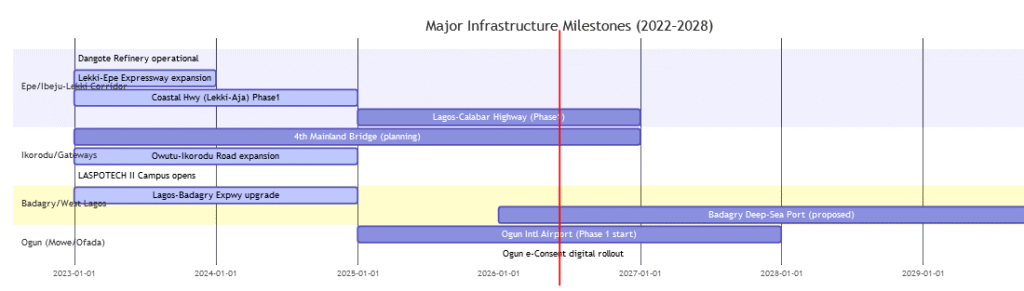
This timeline highlights completed and upcoming projects driving each area’s growth. For example, the Dangote Refinery (Ibeju‑Lekki) and LASPOTECH Lagos (Ikorodu) are already operational, while the 4th Mainland Bridge and Badagry Expressway upgrades are underway.
Chart: The trendlines below illustrate approximate 2023–25 price trajectories in each area (normalized to 2023 base), underscoring Ibeju‑Lekki/Epe’s steeper rise vs. plateauing Mainland zones.
Price trend lines (2023–2025) for land in the seven areas (₦ million per 500 sqm). Ibeju‑Lekki (gold) and Epe (orange) show the fastest growth, while Ayobo (red), Ikorodu (purple), Mowe (teal), Igando (greenish), and Badagry (light green) grow more modestly.
Sources: Authoritative market data and news reports, including NBS/GDP refocus (real estate is now ~10.7% of GDP), Lagos State development plans, and industry publications. Baay Realty’s listings (cited) exemplify current prices in these zones (e.g. Epe’s GreenCity estate). Where exact figures are unavailable (e.g. Ayobo titles), assumptions are noted. All data are cross-checked against recent NigeriaPropertyCentre and company reports.